What happens when two companies obsessed with closing the gap between business intent and technical execution join forces?
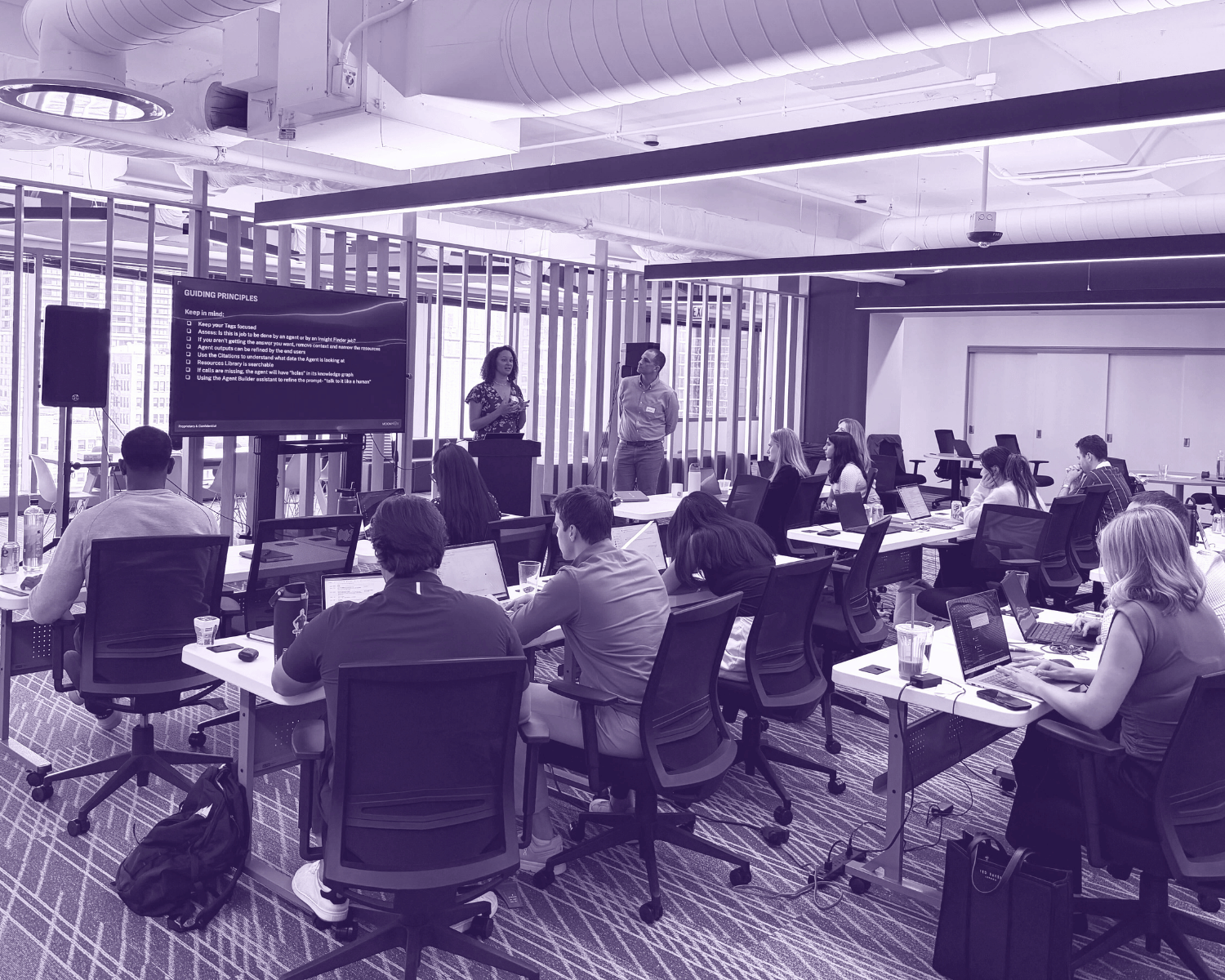
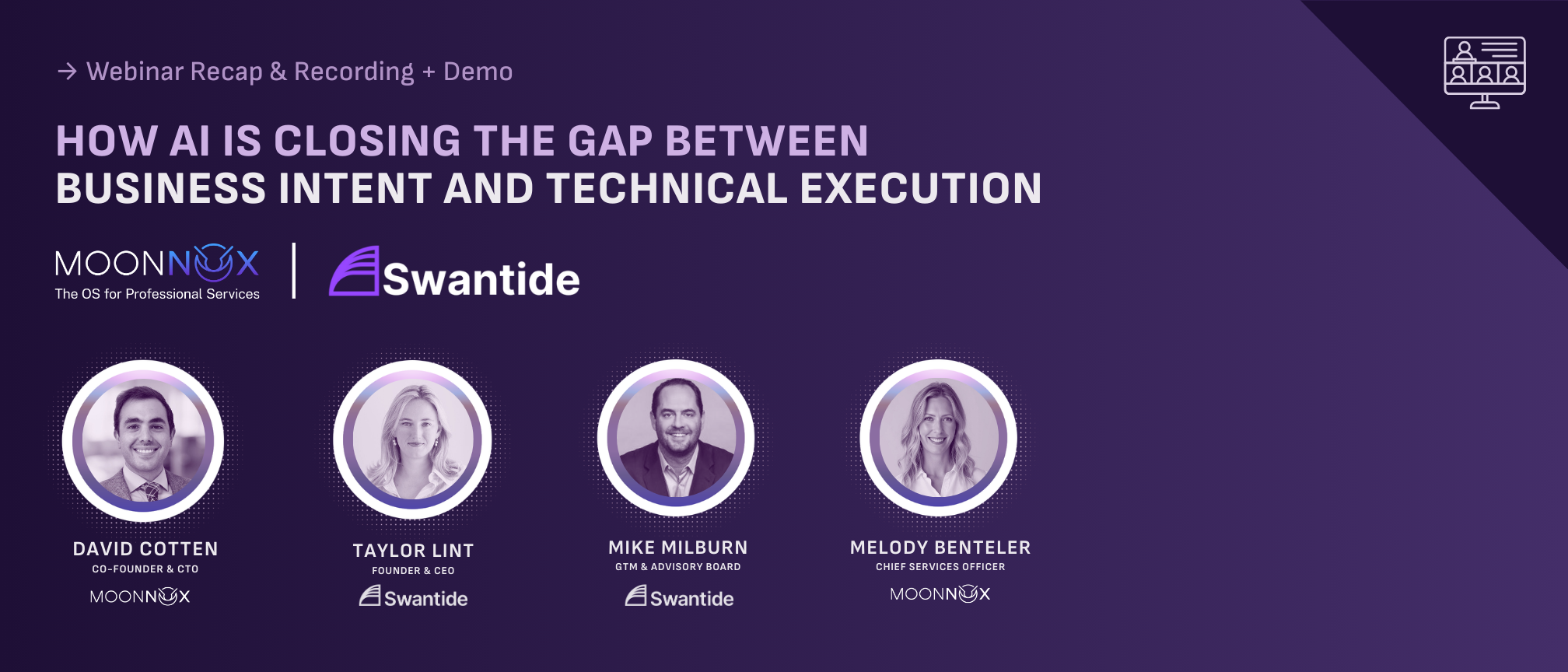
Last week, we hosted our first webinar with Swantide since announcing our partnership and the energy in the (virtual) room was incredible. We had Salesforce ecosystem veterans, SI leaders, and hands-on practitioners on to see what we’ve been building toward: a closed loop from capturing client requirements to deployment in Salesforce.
Here’s what we learned, and what it means for the future of professional services delivery.
AI Is No Longer Optional
Mike Milburn, who sits on Swantide’s board and spent 15 years at Salesforce (including founding the Service Cloud team), didn’t mince words: “In spring of 2026, every single company—end customer, SI, and ISV—has to use AI. It’s being mandated by venture and private equity. You can’t escape it.”
Two years ago, almost nobody on customer calls was using AI. Then, somewhere around fall 2025, it flipped from “nice to have” to mandatory with every company now with some sort of AI committee expecting delivery efficiency, productivity gains, and measurable ROI.
This is not about just having AI in your stack. Customers and investors want to see a business model that reflects AI-driven efficiency.
Two Clicks from Requirements to JIRA
The highlight of the webinar was watching the Moonnox + Swantide integration in action.
Step 1: Moonnox captures the context
David Cotten, our CTO, showed how our Call Pilot joins the requirements meeting and listens to the conversation. At the end of the call, an agent surfaces suggested JIRA stories with descriptions pulled from the actual discussion.
Step 2: One click to JIRA
David reviewed the suggested stories, made minor tweaks, and pushed them to JIRA. What typically takes hours of note-taking, digesting, and manual story-writing happened in seconds.
Step 3: Swantide builds it
Taylor Lint, Swantide’s founder and CEO, picked up the JIRA ticket on the Swantide side. The platform automatically generated a solution design document, identified the components needed (in this case, an email template and a flow), and—after a quick human review—deployed the change directly to a Salesforce sandbox.
The total time from requirements conversation to live Salesforce configuration? Minutes.
Context Is the New Moat
Mike articulated something we’ve been saying for a while: in an AI world, context is your competitive advantage. “Think about the last 25 years of being in the ecosystem. Where did all that context from all those customers and meetings and phone calls go? Where does that live?”
For most firms, the answer is: nowhere useful. It’s trapped in someone’s head, buried in email threads, or scattered across disconnected tools. And when that person leaves? The context walks out the door.
That’s the problem Moonnox is built to solve. We capture context passively—from calls, Slack, email, documents—so it can actually be used both by humans, and also by AI tools that need rich, accurate inputs to deliver quality outputs.
As David put it: “The output is only as good as the prompt. And the prompt is only as good as the context that feeds it.”
The Build vs. Buy Conversation
Mike delivered what might be the most important warning of the webinar: “This is a buy conversation, not a build conversation.”
We know from our conversations with customers that the temptation to build AI tools internally is strong. But systems-grade AI—the kind that integrates into delivery workflows—is fundamentally different from consumer-grade AI. You can’t just “talk to GPT” and call it transformation.
Building requires thousands of hours of product development. It pulls your smartest people off client work. And when that person leaves? You’ve created an orphaned system that your future acquirer won’t value.
The firms winning right now are the ones partnering with companies like Moonnox and Swantide building purpose-built tools, and keeping their talent focused on what they do best: delivering value to clients.
The Q&A
The Q&A surfaced great questions:
How does Swantide do impact analysis?
Because Swantide has the full context of your Salesforce metadata, it performs impact analysis during solution design. It knows if you already have a closed-lost flow running and will add logic there rather than duplicating processes.
How does Moonnox connect to our tools?
Our agents connect to the tools you’re already using, passively capturing context without adding extra steps. We support JIRA, Smartsheet, Monday.com, Notion, and 50+ other tools, with more coming on board weekly.
What are the time/cost savings?
Mike’s answer: “15-30% today and rising quickly.” But efficiency isn’t the only metric. We’re also seeing quality improvements—AI can catch things humans miss—and follow-on business from clients who trust firms using modern tools.
Are the tools good enough to replace nearshore strategies?
Mike’s take: “The tools are that good.” The conversation shouldn’t be about nearshore vs. offshore, it should be about AI enablement. Junior resources using these tools can accomplish what senior resources did before, which changes the entire cost structure.
The Opportunity
There’s a lot of anxiety in the SI ecosystem right now. But Mike offered a reframe: “This is an opportunity to return to what the ecosystem was built to do. Let’s have fun, let’s grow businesses, and let’s deliver results for customers.”
Taylor echoed the sentiment for practitioners, saying that the learning curve starts today.
The Takeaway
If you take nothing else from the webinar, start asking yourself these questions:
- Where does your context live?
- Who owns it?
- How do you reduce friction in execution?
- Where can that give you leverage as you grow?
The ground is shifting. But there is a path forward, and it starts with building the capabilities that can’t be commoditized by consumer-grade AI tools.